
Brand Development
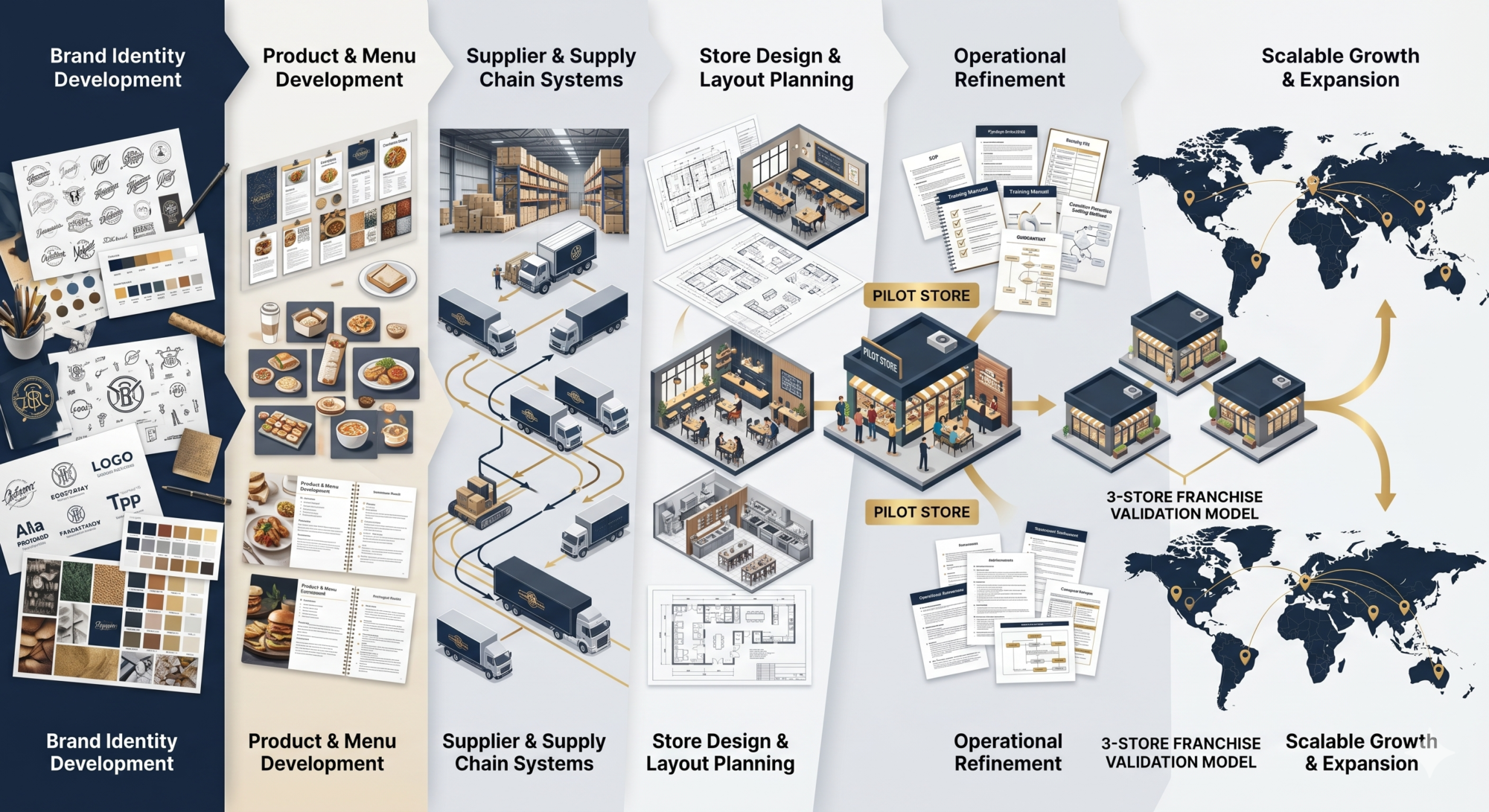
— OUR SERVICES
Brand Development
Building a franchise brand requires more than strong visual design. It requires a market-ready identity, a clearly defined customer promise, and a structured system that new operators can apply consistently across multiple locations. Franchise In A Box helps businesses in Durban, KwaZulu-Natal, and across South Africa build franchise brands that are commercially positioned, operationally practical, and genuinely built to grow.
Why Brand Development Is Different for a Franchise Business
A standalone business can rely on the founder’s personal presence to communicate the brand. A franchise system cannot. Every operator in the network needs to be able to deliver the same identity, the same standards, and the same customer experience — independently, consistently, and without constant supervision. That is what separates brand development for franchising from ordinary branding work. It must be systematic from the outset.
1. Brand Identity and Strategic Positioning
Brand development begins with establishing the strategic foundation — the positioning, naming direction, visual identity principles, and communication style that will define how the business is experienced by customers across every touchpoint.
Strategic Brand Naming
The name must be distinctive, commercially scalable, legally available, and aligned with the intended market position — not simply memorable in isolation.
Logo and Visual Identity
A professional logo reflects the brand’s personality and positioning and is developed as part of a complete visual system, not as a standalone asset.
Colour and Visual Language
Colour choices communicate commercial intent and emotional tone. The right palette for a value-focused takeaway brand is fundamentally different from one suited to a premium sit-down concept — and both must work practically in signage, packaging, and digital formats.
Corporate Identity and Tone of Voice
Typography, design rules, language style, and visual consistency guidelines give franchisees and their teams a clear reference for applying the brand correctly.
2. Product and Offer Architecture
After the brand direction is set, the product or service offer must be structured to match the intended customer, the pricing model, and the operational reality of the business. A franchise must deliver the same quality and consistency whether it is the first location or the fifteenth — which means every product decision needs to be made with replication in mind, not just customer appeal.
- A focused product range aligned with the target market, price positioning, and brand identity
- Clear product roles — each item defined as a hero product, a margin driver, or a traffic builder
- Standardised recipes, portion specifications, and preparation methods designed for consistent execution across locations
- Operational feasibility review confirming that the offer can be produced at the required speed, cost, and quality level
3. Supplier and Supply Chain Structuring
Franchise consistency depends heavily on what goes into the product. Variable ingredient quality, unpredictable lead times, or inconsistent supplier performance all create brand risk — particularly as the network expands. Supplier structuring addresses this by defining the procurement framework before expansion begins.
- Quality and specification standards: Every supplier is assessed against consistent quality criteria and documented specifications so that every location receives the same inputs.
- Pricing and supply stability: Long-term pricing arrangements and supply continuity planning protect both the franchisor and franchisees from unnecessary cost exposure.
- Distribution capability: Suppliers must be able to serve multiple locations reliably — not just the first site. This is assessed as part of the supplier selection process.
4. Store Design, Layout, and Equipment
The physical environment is where the brand becomes real for customers. Layout, finishing, signage, and equipment choices all shape the experience and determine how efficiently the operation runs. Poorly designed stores are harder to staff, slower to serve, and less consistent in the experience they deliver.
- Customer flow and layout: The front-of-house design is planned to support customer movement, reduce wait times, and create a strong first impression.
- Kitchen and back-of-house efficiency: Operational layout prioritises workflow, staff movement, and the practical realities of high-volume service.
- Equipment standardisation: Consistent equipment specifications across locations support uniform output, simpler staff training, and more manageable maintenance.
5. Pilot Store Development and Refinement
A pilot store provides real-world validation before broader expansion begins. It tests the brand, the product, the systems, and the customer response in a live operating environment — and identifies what needs to be adjusted before those adjustments become expensive across multiple locations.
During the pilot phase, operational workflows, staffing models, pricing, product performance, and customer behaviour are all evaluated against the original assumptions. What works is documented. What does not is refined. The outcome is a franchise model that is proven, not just projected.
6. Controlled Early Expansion — The 3-Store Approach
Early franchise expansion works best when it is deliberate rather than rapid. A controlled multi-store strategy — typically three stores in a defined area before broader rollout — allows the business to prove that its brand, systems, and support model perform consistently beyond the original site.
- Market presence and brand recognition: Multiple locations in a defined area create visible, credible market presence — accelerating brand familiarity and consumer trust.
- Systems validation at scale: Operating multiple locations simultaneously exposes any gaps in supply, training, management, or operational consistency that a single pilot may not reveal.
- Proof of replicability: Demonstrating that the model performs consistently across independently managed sites is the clearest possible evidence that the franchise system works — for prospective franchisees and potential investors alike.
7. Launch Marketing and Brand Visibility
A well-built brand still needs a structured go-to-market approach. Launch marketing connects the brand identity and positioning to the channels, messages, and audiences that will generate awareness, trial, and loyalty in the early stages of operation.
- Brand launch strategy: A planned introduction of the concept to the market — defining channels, timing, messaging, and success metrics from the outset.
- Digital presence: Social media, Google presence, and where relevant, delivery platform integration are established to support customer acquisition and brand visibility.
- Local area marketing: Individual store performance is supported by targeted local marketing that drives footfall and builds community awareness.
- Brand storytelling: A clear, consistent brand narrative — communicating identity, values, and product differentiation — is developed for use across all channels.
Frequently Asked Questions
What is franchise brand development?
It is the process of building a business identity, product offer, and operational system that can be replicated consistently across multiple locations — combining positioning, design, supply structuring, and market readiness into one integrated programme.
Why is brand consistency critical for franchising?
Because customers expect the same experience regardless of which location they visit. Inconsistency erodes trust — in the customer, in the franchisee, and in the system. Structured brand development creates the foundations that make consistency achievable.
Does this service include product and rollout planning?
Yes. Effective franchise brand development covers visual identity, offer structure, supplier considerations, operating standards, pilot development, and launch readiness — not just logo design.
Do you work with businesses in Durban and across South Africa?
Yes. The service is designed for businesses in Durban, KwaZulu-Natal, and across South Africa at various stages of growth.
“You’re not in the business of hamburgers. You’re in the business of people, and systems is what makes it work.”
— Ray Kroc (McDonald’s)
Need to register your Franchise at the Banks?