
Franchise Readiness
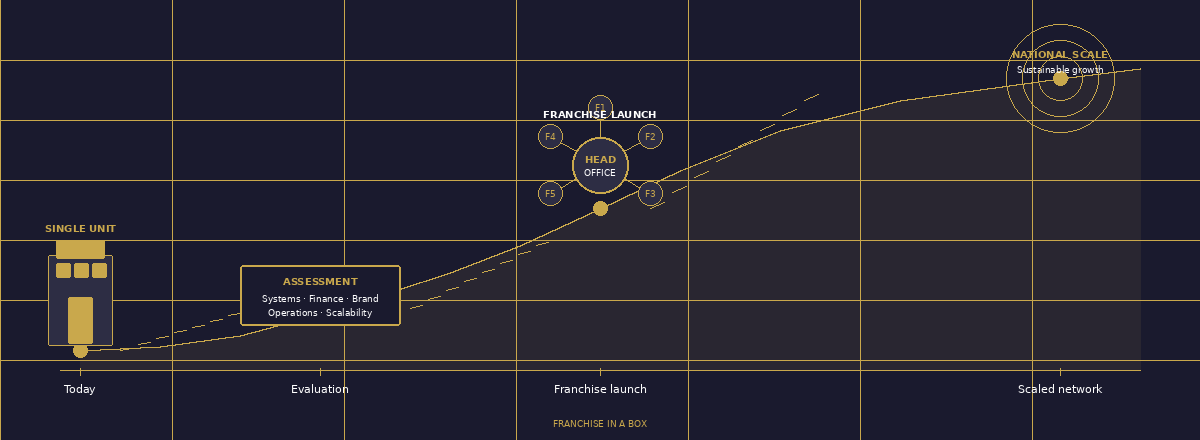
— FREE ASSESSMENT
Is Your Business Ready to Franchise?
A franchise readiness assessment is the structured process that determines whether your business is genuinely prepared for franchise expansion — or whether important foundations still need to be built first. At Franchise In A Box, we help business owners across South Africa make this determination with clarity, removing the guesswork from one of the most significant decisions you will make as an entrepreneur.
South Africa’s franchise sector contributes an estimated R1 trillion to the national economy and employs around 500,000 people across 727 active franchise systems. But only businesses built on proven systems, consistent profitability, and scalable operations are positioned to claim their share of that growth.
Many businesses have real franchise potential. Far fewer are operationally ready to act on it. Understanding the difference — before you invest in franchise development — protect your brand, your capital, and the franchisees who will eventually trust you with their livelihoods.
What Is a Franchise Readiness Assessment?
A franchise readiness assessment is a strategic evaluation of your business across the core areas that determine whether your model can be successfully replicated by independent operators — while maintaining consistent quality, customer experience, and profitability.
The central question the assessment answers is this: can an average operator, equipped with your documented systems, run this business successfully without relying on your daily involvement?
If the answer is yes, you have a franchiseable business. If the answer depends on your personal knowledge, relationships, or instinct, further systemisation is required before expansion is viable.
The assessment evaluates your business across seven key areas:
- Financial performance and profitability
- Operational systems and documentation
- Training capability and transferability
- Brand strength and market positioning
- Proven customer demand
- Unit economics and franchisee return potential
- Franchise support capacity and infrastructure
Why Franchise Readiness Matters
Many businesses attempt franchising too early. Without proper systems, profitability, or support structures, franchise expansion can lead to operational inconsistency, brand damage, franchisee failure, and legal complications under South Africa’s Consumer Protection Act.
A proper readiness assessment helps you:
- Understand whether your business is genuinely scalable
- Reduce franchise expansion risk significantly
- Identify operational weaknesses before rollout
- Build stronger, more defensible franchise foundations
- Improve long-term franchisee success rates
- Prepare for sustainable, structured growth
Franchising should only begin once the business model is proven, teachable, profitable, and operationally stable. According to FASA data, 80% of franchise businesses survive beyond three years — compared to just 20% of independent SMEs.
Six Core Requirements for a Franchise-Ready Business
Many businesses attempt franchising too early. Without proper systems, profitability, or support structures, franchise expansion can lead to operational inconsistency, brand damage, franchisee failure, and legal complications under South Africa’s Consumer Protection Act.
1. Proven Profitability and Financial Stability
Franchisees invest in businesses with a track record of commercial success. Your financial model must demonstrate that an independent operator can achieve sustainable returns.
- Consistent profitability for at least 12 to 24 months
- Reliable and predictable cash flow
- Strong gross profit margins
- Sustainable operational costs
- Proven and recurring customer demand
- Healthy unit economics with a clear break-even timeline
2. Replicable Operating Systems (SOPs)
Franchise businesses must operate through systems, not personality. Detailed Standard Operating Procedures allow another operator to run the business consistently.
- Comprehensive operations manuals
- Opening, closing, and daily procedures
- Customer service and quality control standards
- Inventory management and supplier systems
- Staff management, HR, and health and safety procedures
- Marketing and promotional procedures
3. Strong, Protectable Brand Identity
A franchise brand must be distinct, professionally developed, and consistent enough to maintain standards across multiple independently operated locations.
- Registered trademarks and protected intellectual property
- Consistent visual identity and defined brand standards
- Clear market positioning and defined target audience
- Established customer trust and brand recognition
- Defensible differentiation from competitors
4. Franchise-Viable Unit Economics
Strong unit economics are critical. Both the franchisee and the franchisor must earn sustainable returns for the model to work long term.
- Healthy gross profit margins sufficient to absorb royalty fees
- Reasonable and transparent startup costs
- Sustainable labour cost percentages
- Strong average transaction values
- An acceptable franchisee ROI timeline
5. A Trainable, Teachable Business Model
A business is only franchiseable if it can be effectively taught. Your model should allow a new franchisee to learn and operate within approximately 30 to 90 days.
- Structured onboarding and induction programme
- Operations, POS, and systems training
- Staff management and customer service standards
- Financial controls and stock management
- Sales, marketing, and compliance requirements
6. Infrastructure to Support Franchisees
Franchising is not passive income. It requires ongoing support infrastructure. Successful franchise brands invest heavily in franchisee support.
- Dedicated franchise support personnel
- Site selection and setup guidance
- Ongoing operational audits and coaching
- Marketing and promotional support
- Supplier management and quality assurance systems
- Structured franchise onboarding process
The 10-Point Franchise Readiness Test
Use the checklist below to do an honest preliminary evaluation of your business. For a detailed professional assessment, contact our team.
| # | Franchise Readiness Question | Yes / No |
|---|---|---|
| 01 | Has the business been consistently profitable for 12 or more months? | ☐ |
| 02 | Can the business operate successfully without your daily presence? | ☐ |
| 03 | Are all systems and procedures documented in manuals and checklists? | ☐ |
| 04 | Can the business model be taught to a new operator within 90 days? | ☐ |
| 05 | Is there proven, sustainable customer demand for your product or service? | ☐ |
| 06 | Is your brand identity clear, professional, protected, and distinct? | ☐ |
| 07 | Are your unit economics strong enough for franchisees to earn meaningful returns? | ☐ |
| 08 | Do you have capital available for franchise development, legal documentation, and marketing? | ☐ |
| 09 | Are you prepared to transition from operator to trainer, mentor, and support leader? | ☐ |
| 10 | Is the market opportunity large enough to sustain long-term franchise network growth? | ☐ |
8 – 10 Yes
Strong franchise potential. You are likely ready to begin structured franchise development.
5 – 7 Yes
Franchise potential exists, but targeted preparation is still required in key areas.
0 – 4 Yes
Focus on strengthening your core operations and systems before pursuing franchise expansion.
Common Signs a Business Is Not Yet Ready to Franchise
Identifying gaps before you begin franchise development is far less costly than discovering them after you have signed agreements and onboarded franchisees.
- The owner is involved in every operational decision
- Profitability is inconsistent or seasonally dependent
- Systems exist verbally rather than in written documentation
- Staff training is informal and undocumented
- Customer experience varies significantly between visits
- The brand lacks clear market differentiation
- Gross profit margins are insufficient to support royalty fees
- Supplier relationships and supply chains are unstable
- Operational performance depends on specific individuals rather than systems
- Brand trademarks and intellectual property are unregistered or unprotected
Most of these gaps can be resolved through structured operational development and documentation. Explore our services to understand how we help businesses build franchise-ready foundations.
Industries Suited to Franchising in South Africa
Franchising works across a wide range of industries. The business model and strength of systems matters far more than the sector itself.
- Restaurants and cafés
- Fast food and quick-service restaurants (QSR)
- Retail businesses
- Service businesses
- Fitness studios
- Beauty and wellness brands
- Education and tutoring
- Automotive services
- Home improvement and cleaning services
- Professional and business services
- Health and medical services
How Franchise In A Box Helps
Franchise In A Box works with business owners throughout South Africa to evaluate franchise readiness, close operational gaps, and build the systems required for sustainable expansion.
- Franchise readiness assessments
- Operations manual development
- SOP documentation and systemisation
- Franchise system structuring and model design
- Franchise agreement coordination
- Training system development
- Brand positioning and franchise brand development
- Franchise rollout planning and implementation support
- Franchisee onboarding frameworks
Learn more about our franchise documentation services or our approach to training system development.
Frequently Asked Questions
How long should a business operate before franchising?
Most businesses should demonstrate at least 12 to 24 months of stable, consistent profitability before commencing franchise development.
Can a small business franchise successfully?
Yes. Many of South Africa’s most successful franchise systems began as single-location businesses. What matters is whether the system is teachable — not how large the business already is.
What is the most common mistake businesses make before franchising?
Attempting to franchise before systems, profitability, and support infrastructure are properly established. The assessment process exists precisely to prevent this.
Do I need an operations manual before franchising?
Yes. Detailed operations manuals and SOPs are non-negotiable for any franchise system. Without them, replication is inconsistent and support becomes reactive rather than structured.
Is franchising the right growth strategy for every business?
Not always. Some businesses are better suited to company-owned expansion, licensing, or joint venture structures. A readiness assessment evaluates whether franchising genuinely serves your growth trajectory.
How does Franchise In A Box conduct a readiness assessment?
Our assessment evaluates your business across financial performance, operational systems, brand strength, training capability, unit economics, market demand, and support infrastructure.
“The dream of owning your own business is powerful. The discipline to build one worth replicating is what separates ambition from legacy.”
— Franchise In A Box
Need to register your Franchise at the Banks?